top of page
Butterfly populations are a very good indicator of the health of an area's ecosystem !!


Also known as the Starry Cracker.
Hamadryas laodamia is a butterfly native to Caribbean areas, as well as Central America and tropical South America.
They occur at altitudes of up to 900 m (3,000 ft) on both the Pacific and Atlantic slopes of the Andes Ranges, but are most common in lowland forests in the Caribbean region where they inhabit the mid and upper parts of the canopy.
Both sexes spend most of their time basking high up on tree trunks, often 10 meters or more above the ground.
They like to rest with their heads down on the trunks of trees with their wings flattened against the bark.
They sit there for hours with wings outspread, always facing downwards to keep a watchful eye for potential mates.
They are commonly known as Crackers due to the ability of the males of several species to produce a sound similar to the crackling of bacon in a frying pan.
The sound is produced as the butterflies take off and is made by clicking a pair of spiny rods at the tip of the abdomen against bristles on the anal claspers.
Only males can produce the sound, but both sexes can detect it.
The reason for the sound is unknown.
It may possibly deter competing males from occupying the same territory or it could be a trigger to initiate the first response from females during courtship.
They are on wing from sunrise to sunset and are rarely seen away from tree trunks, and can be seen in flight year round.
All Hamadryas species have a beautiful calico pattern on their dorsal side.
Their average lifespan as adults is approx. 2 – 3 weeks.
* As members of the Brush Footed (Nymphalidae) family, they use their shorter pair of front legs for food tasting, and their two pairs of their longer rear legs for propulsion.

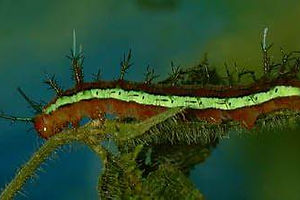
Diet: caterpillars feed on the leaves of Dalechampia triphylla, a vine in the family Euphorbiaceae.
Diet: adults do not take nectar but get their nourishment by taking juices from rotting fruit and human sweat. Consequently, they are not considered pollinators.
Avg. wingspan: 6.35 – 8.6 cm / 2.5 to 3.4 “.
Family: Nymphalidae (Brush Footed)


The single biggest threat to butterfly survival is habitat destruction!!
bottom of page