top of page
Butterfly populations are a very good indicator of the health of an area's ecosystem !!


Also known as the Eastern Knapwood Fritillary.
Malitaea phoebe inhabits flowery meadows and plains, but may also be found in stonier places such as rocky hills, at elevations from 0 - 1200 m.
They are considered a fritillary of hot, flowery places where knapweed grows.
They are found on wing from April to September, depending on the location, and will have several broods from April to September, with a shorter window at higher altitudes.
Their forewings are more pointed than the eastern knapweed fritillary, but are equally variable in color and distinctive markings.
Their black markings are usually joined but may instead cover a majority of the wing or even very little of it.
The species features a reddish yellow submarginal lunate (crescent-shaped) spot between the two median veins that reaches its vertex, considerably further into the disc than the other yellow lunate spots.
This pattern is present on both the forewings and the hindwings.
Additionally, the submarginal lunule between the first and second median veins projects further basal than the other lunules of the same row.
There is slight sexual dimorphism evident, as the females are consistently somewhat larger than the males, with stockier bodies and brighter colors.
Potential predators of adults include birds, spiders, larger insects such as mantises and dragonflies and small mammals.
In certain areas, they are critically endangered !!
North of the Alps, Melitaea phoebe is in sharp decline and unfortunately, has apparently already disappeared in the Kaiserstuhl region.
The main cause, as is usually the case, is habitat loss due to agriculture (vineyards, other intensifications), overbuilding, succession, and reforestation

Avg. wingspan: 3.4 - 50 cm. / 1.33 – 1.97 “
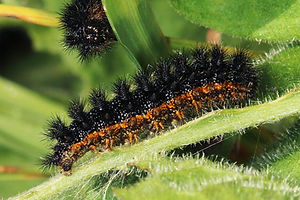
Diet: larva feed on Plantain (plantago), Veronica, Linaria, Buddleja, Digitalis, as well as other species dependent on location.
Diet: adults take nectar from Thistles (cirsium and carduus species), Knapweed (centaurea species), Asteracea flowers, Buddleja flowers, and Vetches (vicia species)
Family: Nymphalidae (Brush footed)
* As with most Brush Footed butterflies, they will use their shorter pair of front legs for food sampling, and their two longer pairs of rear legs for propulsion.

The single biggest threat to butterfly survival is habitat destruction!!
bottom of page