top of page
Butterfly populations are a very good indicator of the health of an area's ecosystem !!


Also known as the Faunus Comma or the Faunus Anglewing.
Polygonia faunus’ preferred terrain includes forests, mountain stream sides and canyons.
Their territory includes North America south of the tundra and Central Alaska south to central California and northern New Mexico, east across southern Canada and the Great Lakes region to New England and the Maritimes.
A separate population occurs in the southern Appalachians
These somewhat rare butterflies are characterized by extremely ragged wing edges.
They are geographically quite flexible.
The dorsal side of their wings is reddish brown with wide dark borders.
The hindwing border contains a row of yellow spots.
The ventral side of the wings is grey brown, but the outer half is lighter, with greenish lichen simulating submarginal spots in the males.
Also, the dorsal hindwings have an L or a C-shaped silver spot centered on the wing.
In the females the wings are more uniform, with a dull gray ventral side.
The Eastern Comma, Gray Comma, and Question Mark can all be mistaken for the Green Comma. They all occur within the Green Comma’s range. (A couple of keys for identifying the Green Comma include more jagged wing edges, darker markings, and green mottling on the underside of the wings.)
North American populations of Polygonia species can be distinguished from those of Polygonia c-album by the fact that they occur only in cooler regions, with only one brood and without seasonal dimorphism.
One brood occurs, from May – Aug.
Adults overwinter to fly and mate the following spring.
Conservation measures are not usually required, and management needs have not been reported.
They are considered demonstrably secure globally, though they may be quite rare in parts of their range, especially at the periphery.

Avg. wingspan: 4.5 - 6.4 cm / 1.77 - 2.52 “
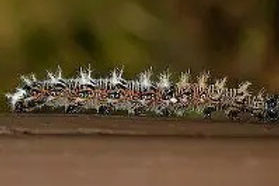
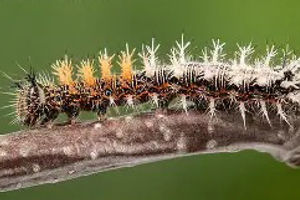
Diet: caterpillars feed on small Pussy Willow (Salix humilis), Black Birch (Betula lenta), Alder (Alnus), Western Azalea (Rhododendron occidentale), and Gooseberry (Ribes).
Diet: adults get their nutrients from flower nectar, tree sap, dung, and carrion. Males will also “puddle” to get salt and nutrients from moist ground.
Family: Nymphalidae (Brush Footed) Anglewing Genus: Polygonia.
The single biggest threat to butterfly survival is habitat destruction!!
bottom of page